
- Smriti Mehndiratta
- 29-06-2026
In 2008, when the world financial crisis shook markets, companies were concerned about liquidity.
In 2020, during COVID, they were bothered about survival.
In 2026, an increasingly key question sits in boardrooms across the globe: Can we still be trusted?
It is a question that spans across sectors, geographies and corporate structures. While organisations continue to invest substantially in tech, innovation and expansion, many are realizing that one of the most valuable assets required – credibility cannot be purchased, built overnight or shown in a balance sheet.
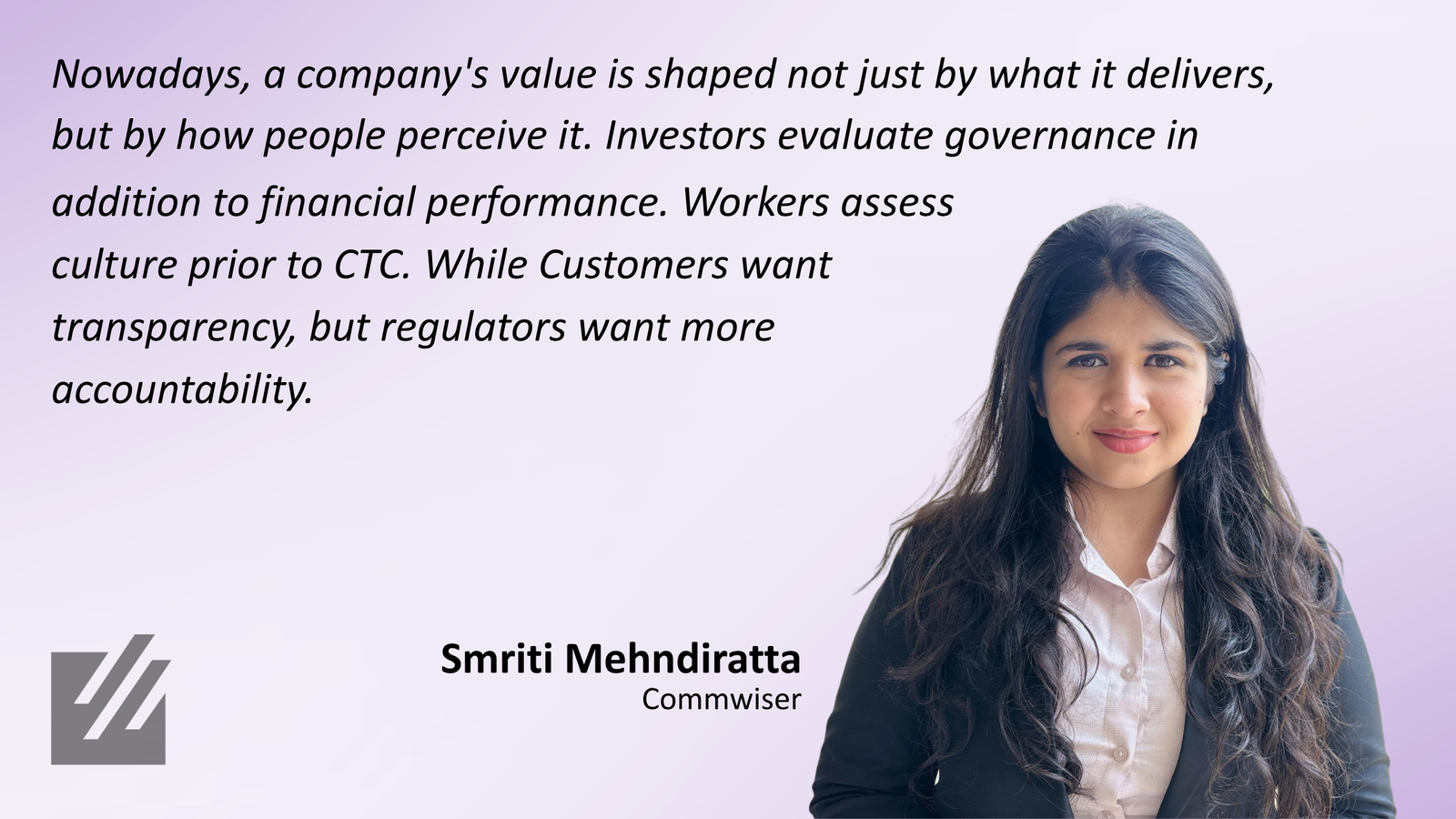
Nowadays, a company’s value is shaped not just by what it delivers, but by how people perceive it. Investors evaluate governance in addition to financial performance. Workers assess culture prior to CTC. While Customers want transparency, but regulators want more accountability.
Perception has an impact on business results as well as reputation in today’s corporate environment.
The Growing Trust Deficit
The numbers also present an interesting narrative. As per the 2025 Edelman Trust Barometer, 61% of individuals globally expressed moderate to high levels of resentment towards governments, companies, and institutions. In short, trust is becoming more difficult to acquire and more easily lost. Due to which, organizations are no longer being given the benefit of the doubt.
Every decision is questioned.
Every statement is carefully reviewed.
Every silence is observed.
As a result, reputation is becoming a corporate risk that directly affects growth, investment, and stakeholder confidence, rather than only a communications concern.
Companies No Longer Build Reputation on Their Own
Companies no longer have control over their own narratives, which is probably the biggest observed during the recent past.
Social media has completely transformed the manner of building and weakening reputation. A complaint from a customer may swiftly become national headlines. More so than a recruitment initiative, an employee’s LinkedIn post might influence employer impression. A paid advertisement has less of an impact on buying options than a creator’s evaluation. Narratives now spread more quickly than organizations can react when AI-generated content and false information are incorporated.
Every employee has a platform.
Every customer has an audience.
Public perception can be influenced by any stakeholder.
The era of well-crafted corporate communications has been replaced by an era of constantly ongoing public scrutiny.
Organizations are now judged more on whether their actions consistently fulfil their commitments than on the statements they make.
The Companies That Retrieve Faster
Not all crises turn into reputational crises.
While some organizations recover from leadership disputes, cyber-attacks, or regulatory probes with comparatively little harm, others take years to regain their reputation.
The trust they had established prior to the crisis often makes the difference.
Failures are accepted by stakeholders. Inconsistency, a lack of disclosure, or recurrent failures are what people find difficult to tolerate.
People are more likely to listen to and embrace an organization’s side of the story when trust already exists.
When it doesn’t, even a skilfully constructed response finds it difficult to alter perspective.
What Should Organisations Do Differently?
It is no longer possible to approach developing trust as a reactive process.
Long before a crisis arises, continuous intervention is needed.
This calls for being candid and upfront even in awkward conversations. It entails making sure that leadership remains intact behind thoughtfully composed words during uncertain times. It involves giving the same attention to workers and clients as investors does. Above all, it means acknowledging that reputation is shaped by business actions on a daily basis, not only in times of crisis or public appearances.
Therefore, controlling narratives is no longer the primary objective of communication. The purpose is to establish enough credibility for stakeholders to be willing to trust you.
The Next Competitive Advantage
Technology can be replicated.
Products can be copied.
AI is rapidly transforming information, content, and even creativity into commodities.
But trust is still hard to develop and cannot be developed overnight.
The companies with the largest advertising budgets or the loudest campaigns might not be the ones that take the lead over the next ten years. It will be the one, who continuously gain the trust of their clients, staff, investors, and regulators even in difficult circumstances.
Looking Ahead
The pressure on organisations to be more accountable, authentic and upfront seems unlikely to fade. If anything, it will keep expanding as workers get more outspoken, customers become more knowledgeable, and internet platforms continue to instantly shape public opinion.
Trust is becoming a standard expectation rather than a differentiation exclusive to a select group of highly regarded brands.
That completely alters the debate for corporate leaders.
Reputation is no longer something to protected just after a disaster.
It is something that needs to be developed daily.
Because in a world where perception could shift in minutes, but credibility takes years to be gained, trust might be the most precious company asset that never shows up on a balance sheet.